

The Control Panel


The Heart of it All !


loco page header


page1 side

The Main System Power Boards

Meifford Control Panel


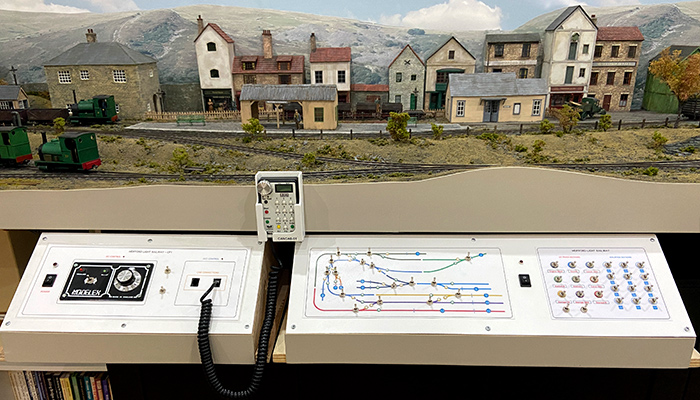
The Control Panel for Meifford has been designed so that the track power and 'other operations', such as point switching are seperated out into two units.

The Power Module

The 'Power' section contains power transformers and both the DCC modules and a DC controller. The DC controller has its own power supply as well. The front panel also has sockets for up to two handheld DCC controllers.

The module can run as a standard DC unit, with control via a Modelex controller, or as a DCC unit which uses MERG components. It is impossible to mix the two methods as two switches need to be enabled for either option to become 'live'. Panel lights indicate which is enabled as does the position of the switches.

A single 'flying lead' power output cable runs to the Control Module and the track section switches. 

As stated, MERG DCC kit-built units are employed - more details can be found below -

Just Click on the image!
 

The Control Module

 The control module houses section switches (for DCC operation they are all left in the 'on' posistion), the 'mimic' track diagram with point switches and indicator lights, plus one of the MERG 12-way servo controllers and the low-voltage power connectors for lighting on the layout.

The track power out from the Power Module is brought in to this unit and then fed back out to the track sections via a connector board. Leads for the isolating sections also feed back to this module. What with servo connections as well, it is quite a busy module!

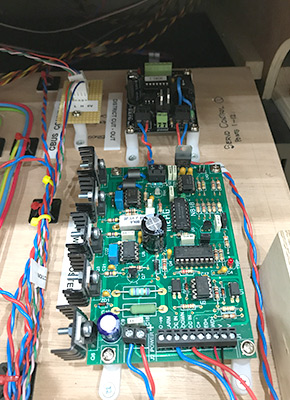
The images below show the interiors of the two modules  (click to enlarge)-

I purposely kept power and control seperate, since it would make life easier should I decide to change the DC / DCC components in the future.

Point operation uses miniature double-pole changeover switches to provide the signal to the servo controller and switch the LED indicators.

All of the wiring on the layout uses PCB mounted miniature connectors, which makes tracing problems, or replacing any wiring a much simpler execise. Even on a small layout cabling can get quite complicated!
Contact

If you have any questions about Meifford or would like to know more about 7mm Narrow Gauge modelling, please do use the form on the Contact Page


 I normally try and answer within a couple of days

MERG Control Panel Units

Why use MERG?

I have always enjoyed electronics and so the decision to make and use the MERG sourced units was an easy one.

Deciding to the use the MERG DCC base station and hand controller, I was initially a little wary as to how it could compare to other commercially available products. I thought it worth the expense buying a set, constructing it and testing it before committing! I was also unsure whether my soldering skills were up to the job, with the handset using tiny surface-mount components.

The testing was a great success, so I made the decision both to go DCC and to do so using the MERG items.

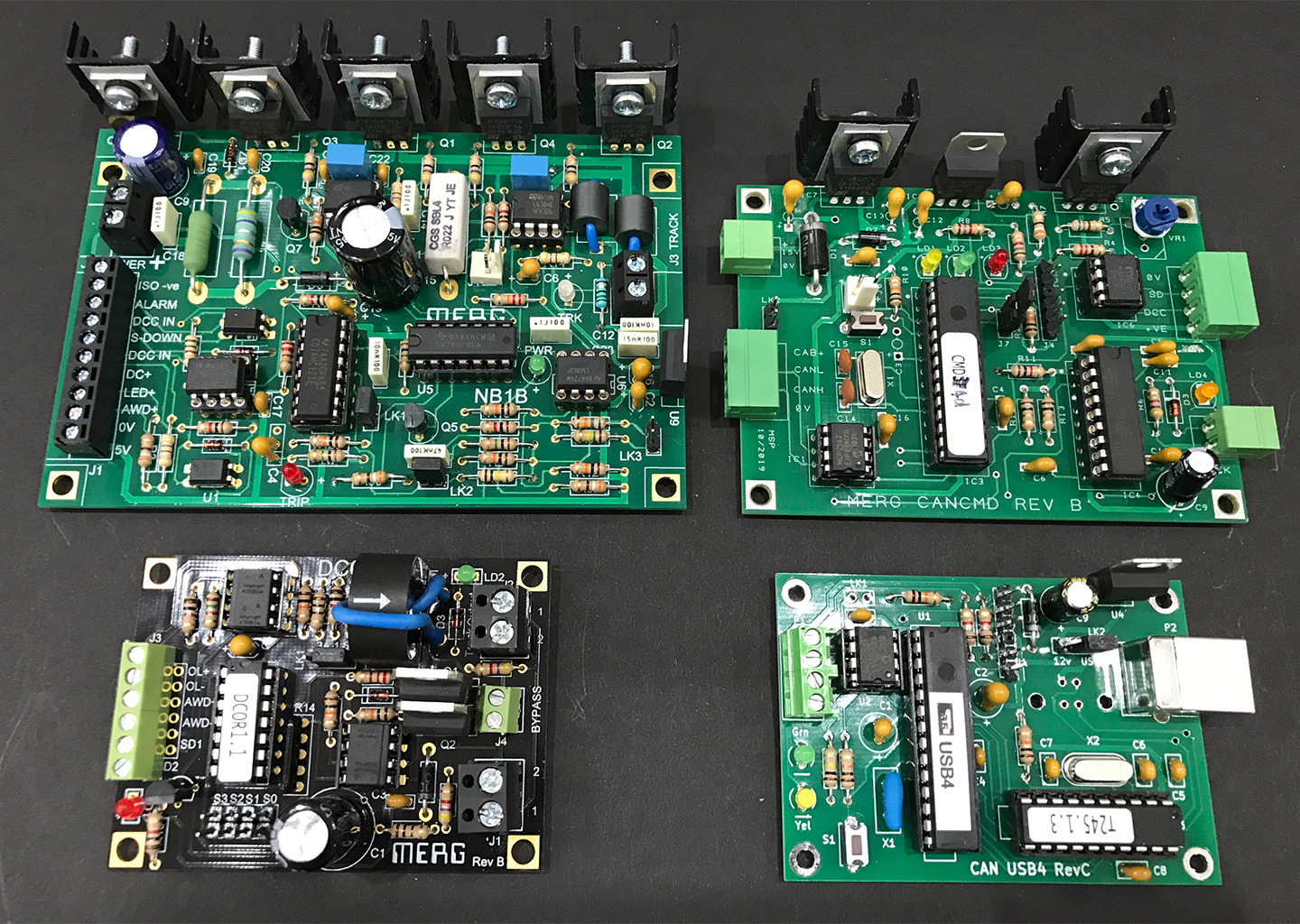
The image below shows the modules used within the control panel (excluding the handset)

merg units 01

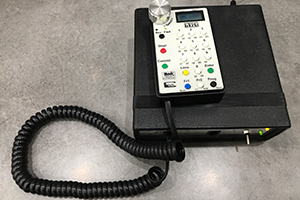
The initial test command station has been mounted into a case, making it portable and it is now used with a 1M section of track for loco programming and test running. The handset is connected using an RJ11 (telephone type) cable and is plugged in to this unit or the main control panel.

So, what did I buy?

The following units were purchased-

  1. The DCC Command Station (CANCMD2 Kit 91A)
  2. The DCC Handheld Controller (CANCAB Kit 92) *
  3. A Power Booster Module (NB2 Kit 59A) - Ups the standard power rating from 1Amp to either 5 or 10 Amps
  4. A District Cut-out Module (DCO Kit 57) providing extra short-circuit protection
  5. A Computer connector Module (CANUSB4 Kit 80A) - Provides link to a computer with JMRA software for programming **

Only the first two modules in the list are essential. The others will depend on your requirements.

Just a word on the MERG kits for these units. The instructions are very comprehensive and all of the parts are very well labelled / identified and it's possible to build these modules quite easily, with moderate soldering skills.

Of course. 'doing it yourself' does mean that there are some substantial savings to be made! I would certainly recommend these modules, especially the controller which I have found gives excellent control of the locos.

Notes

* The Handheld Controller has been modified recently and removed the need for surface-mounted components. It should make the building of this kit much easier 

** Currently software available is only compatible with Microsoft Windows computers